Health Year · For health plans

The Health Year. Prevention that reaches your members.

Twelve health topics in one app for your members. Findings lead to a medical assessment and, where needed, straight into a care pathway, while your plan sees only de-identified figures.

Illustrative example of a Health Year in three layers and four quarters from sign-up. The member completes one health check per month in the app. myoncare reviews every check, assigns a risk level and routes the result. Quarter 1: risk profile plus heart, burnout and colon; the result goes to the member. Quarter 2: teeth, allergies and skin; a finding leads to a recommended medical assessment with a primary care provider. Quarter 3: diabetes and cancer screening; a finding is confirmed and the member moves into the care pathway for cardiovascular-kidney-metabolic (CKM) syndrome. Quarter 4: infection prevention, lungs and anxiety; the health plan receives a de-identified program report for groups of 10 or more.
  1. Q1Months 1–3
    Heart · burnout · colon
    Risk profile + 3 checksResult per person
    • Member: own result
  2. Q2Months 4–6
    Teeth · allergies · skin
    3 checks reviewedAssessment recommended
    • Member: own result
    • Primary care: medical assessment
  3. Q3Months 7–9
    Diabetes · cancer screening
    Finding confirmedOn to the CKM pathway
    • Primary care: medical assessment
    • CKM care pathway
  4. Q4Months 10–12
    Infections · lungs · anxiety
    Program report createdde-identified, groups of 10+
    • Member: own result
    • Health plan: de-identified program report
Why now

Spending is rising. Prevention has to arrive earlier.

Health spending keeps growing faster than the economy, while few adults get all the preventive care recommended for them. Prevention has to reach members before risks turn into illness.

$5.3 tn

in US health spending in 2024, 7.2% more than the year before, or $15,474 per person.

CMS, National Health Expenditure Accounts1
+8.8 %

growth in private health insurance spending in 2024, to $1.64 trillion.

CMS, National Health Expenditure Accounts1
8 %

of US adults aged 35 and older received all the high-priority preventive services recommended for them.

Borsky et al., Health Affairs 2018 (2015 data)2
The Health Year

Twelve stages for your members. One topic per stage.

Every participant starts with a personal risk profile. The app then guides them through twelve health topics, each with a risk check, ongoing support, and results with a report.

1risk profile to start18health topics7lifestyle factors alongside

  1. Start: risk profile covering Personal data, Lifestyle, Pre-existing conditions, Family history, Quality of life.
  2. 1 / 12: Heart health. How are my heart, blood pressure and metabolism doing?
  3. 2 / 12: Burnout & depression. Am I just exhausted, or is there more to it?
  4. 3 / 12: Colorectal cancer & gut health. Which screenings are right for me, and which warning signs should I know?
  5. 4 / 12: Dental health. How healthy are my teeth and gums?
  6. 5 / 12: Allergies & asthma. Is it just hay fever, or should I get my airways checked?
  7. 6 / 12: Skin cancer & skin health. Which moles should I keep an eye on?
  8. 7 / 12: Diabetes. What is my risk of type 2 diabetes?
  9. 8 / 12: Breast or prostate cancer. Which early detection makes sense for me now?
  10. 9 / 12: Testicular or cervical cancer. What should I look out for, and which screenings are right for me?
  11. 10 / 12: Infection prevention & STIs. How do I protect myself, and when is a test a good idea?
  12. 11 / 12: Lung cancer & lung health. How high is my risk, and what screening is available?
  13. 12 / 12: Anxiety disorders. Is this ordinary worry, or should I get support?
Lifestyle programs alongside

Seven lifestyle topics. Free to add in the app.

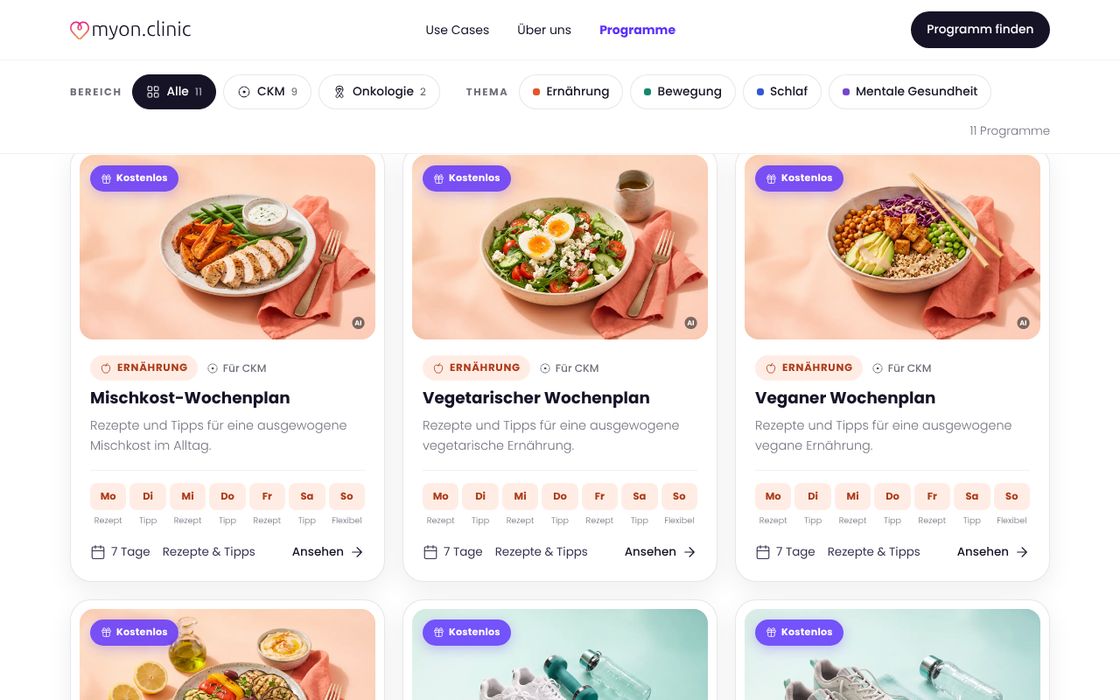
Alongside the twelve stages, seven lifestyle topics run all year. Your members choose matching 7-day programs themselves and start them right in the app, free of charge.
  • Sleep
  • Nutrition
  • Physical activity
  • Resilience
  • Alcohol
  • Smoking
  • Immune system
Program overview in the myoncare app: free 7-day programs with a topic filter, a weekly plan per program and a free badge on every card.

Every stage follows the same principle.

No elevated risk

Stay healthy

  • Recommendations for preventive measures
  • Prevention tips and plain-language information
Moderate risk

Take a closer look

  • Recommendation for further tests
  • Information on possible consequences
  • Recommendation to see a doctor if needed
High risk

See a doctor

  • Clear recommendation to see a doctor
  • Information on the condition and treatment options
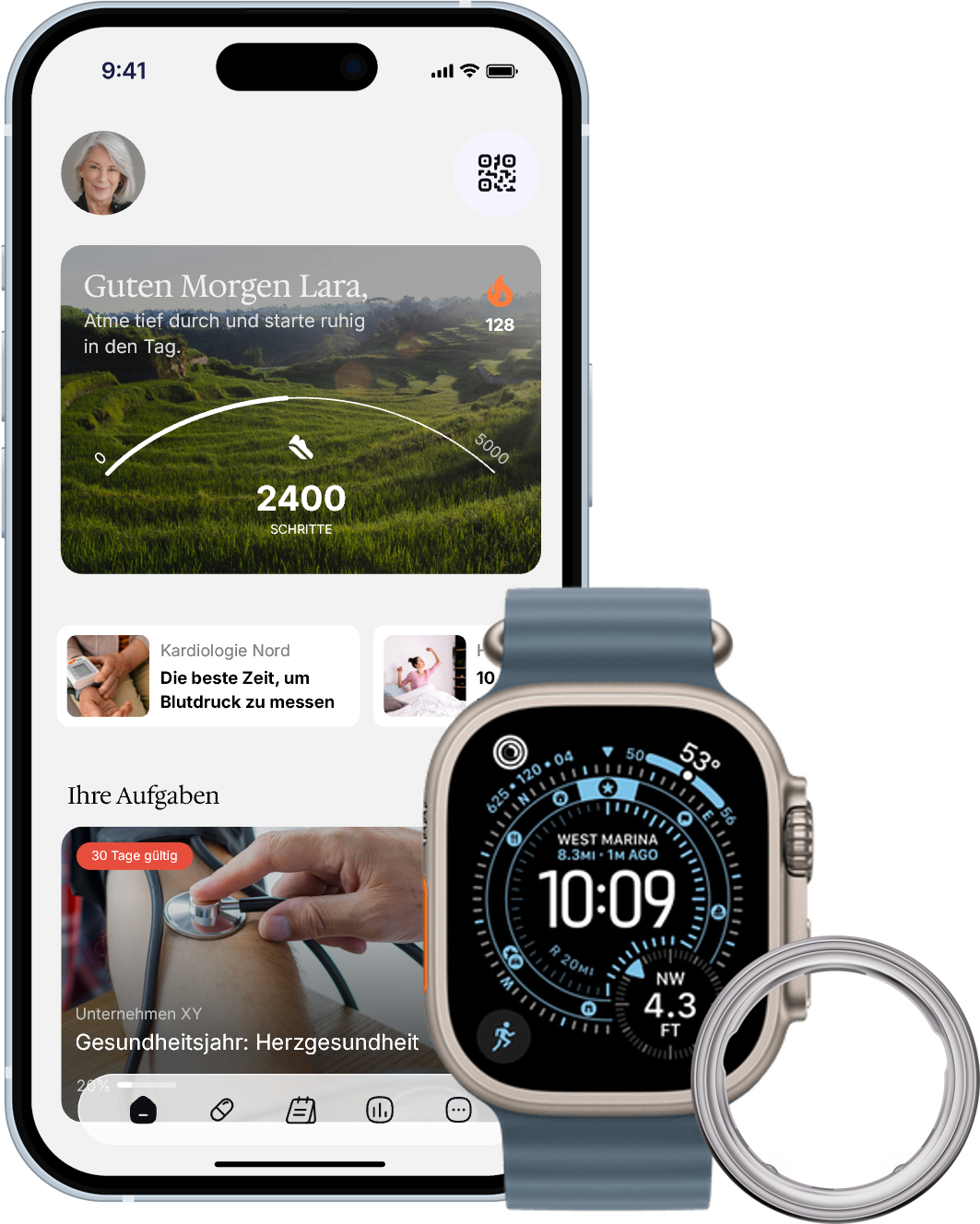
The myoncare app on a smartphone and the platform in a browser
App & platform

A health companion for your members. On any device.

Your members use the Health Year in the myoncare app for iOS and Android or directly in the browser. Content, questionnaires and reminders arrive exactly when they are relevant.

  • Start with a QR codeScan, register, get going. No integration with your IT.
  • App or browserNative app and progressive web app on their own device.
  • Wearables & health dataConnects to Apple Health, Google Health and Withings.
  • Check-ins & remindersShort check-ins and prompts that fit into everyday life.
  • Own resultsEvery participant sees their own results and progress.
  • Secure exchangeChat, video consultations and documents when medical follow-up is needed.
How it works & privacy

Reach and transfers at a glance. Without individual data.

Members screen themselves, the medical team sees findings, and your plan sees only de-identified figures on participation, topics and transfers into care. All data is aggregated and de-identified.

  1. 1

    Members

    screen themselves and see their own results.

  2. 2

    Medical team

    reviews findings, recommends an assessment and, once a finding is confirmed, transfers the person into a care pathway.

  3. 3

    Health plan

    receives a program report with de-identified figures.

Program report 2026 · Sample Health Plan

Participating members
24,600
4.9% of adults
Completed topic checks
198,000
Risk check + 12 stages
Transfers into care pathways
1,240
of which CKM: 610

Participation by region, share of adults

  • Northeast6.2%
  • South5.1%
  • West4.6%
  • Midwest3.8%

Risk distribution, topic: stress

  • No elevated risk 58%
  • Moderate 31%
  • High 11%

Topic focus

  • Stress↑ rising
  • Heart health↑ rising
  • Sleep→ stable

Participation target reached over the year

0%25%50%75%68%JanMarMayJulSepNovDec

Recommendations for 2027

  • Promote the stress program to members aged 30 to 49
  • Reminder about colorectal cancer screening from age 45

Analysis only for groups of 10 or more. Individual results are not visible to the health plan.

Who sees what?

Individual results

are seen only by members themselves and the medical team. Physician–patient confidentiality applies.

Health plan

sees only de-identified, aggregated reports, never individual data. Reports require a minimum group size of 10 people.

Voluntary

Participation is voluntary and requires the member's consent.

Benefits

Good for your members. Good for your plan.

For members

Prevention that fits into everyday life.

  • Twelve health topics on their own smartphone or in the browser
  • Personal recommendations instead of generic leaflets
  • Clear next steps, right into a care pathway where needed
  • Voluntary; individual results stay with members and the medical team
For your plan

Prevention that leads into care.

  • A digital prevention offer for all adult members
  • Early detection with direct transfer into care pathways such as CKM
  • De-identified program report by region and topic
  • A visible offer for your members
From alert to care

Early detection that leads into care.

When a check detects a finding, myoncare guides the member into the right care pathway, with their consent. Example: cardiovascular-kidney-metabolic (CKM) syndrome.

Illustrative example: a member goes through the Health Year. After the risk check and stages 1 to 6 with no finding, myoncare detects a finding in stage 7, diabetes. The member is transferred into the care pathway for cardiovascular-kidney-metabolic (CKM) syndrome: medical assessment with lab values, stage 1 is identified, the lifestyle, sleep and liver modules are added, and primary care, obesity medicine and nutrition counseling are involved. Every new value leads to a new staging. Stages 8 to 12 of the Health Year continue in parallel.
What this means for your plan: Prevention and care run on one platform. The transfer into the pathway can be set up, for example, within your care management or disease management program.

The same principle applies to other pathways, for example in Oncology. More on the CKM pathway: Metabolic syndrome.

Illustrative example. Every clinical decision remains with a physician; moving into a pathway requires consent.

Benefit calculator

What does the Health Year do for your plan?

Four inputs are enough: how many members you reach, what it costs and how much effect is needed for it to pay off.

Your plan

500,000
5%
$60
$8,000
Break-even
0.8%

lower medical spending per participant is enough for the Health Year to pay for itself: $60 of $8,000.

Members reached
25,000
per year
Topic checks
325,000
with full participation
  • Health Year cost per year$1,500,000
  • Cost per member$3.00
  • Cost per member per month (PMPM)$0.25

Model calculation for orientation, not a savings promise.

Assumptions, formula and sources
InputAssumptionBasis
Medical spendingDefault $8,000 per member per yearAverage annual premium for single employer coverage $9,804 in 20263; under the ACA medical loss ratio rules6, at least 80–85% of premiums go to medical care and quality improvement; rounded, own calculation. Use your own figure, especially for Medicare Advantage or Medicaid.
CostDefault $60 per participant per year ($5 per participant per month); costs only for participantsPlaceholder price, to be confirmed; terms for health plans in the quote
Topic checks13 per person: risk check plus twelve stagesStructure of the Health Year

Formula: Break-even = cost per participant ÷ medical spending per member. PMPM = annual cost ÷ members ÷ 12.

Deliberately not included: savings. Robust effect data for this program are not yet available. Whether participants' medical spending changes can be tested in a pilot with evaluation.

Ways to offer it

Three ways to offer the Health Year.

Depending on your lines of business and goals, the Health Year can be offered in different ways, on their own or combined.

Commercial & self-funded

As a member wellness benefit

Plans and the self-funded employers they administer can add the Health Year to their wellness offering for adult members. If incentives are tied to it, the HIPAA and ACA wellness program rules apply.

45 CFR 146.1214
Medicare Advantage

In a rewards and incentives program

Medicare Advantage plans may offer rewards and incentives for health-related activities. Completed stages could count as an activity if the program meets the CMS requirements.

42 CFR 422.1345
Care management

With transfer into care

For the care pathway, such as CKM, the plan uses its care or disease management program and its provider network. myoncare supplies the pathway, platform and documentation.

Agreed per plan

This overview is not legal advice. For Medicaid managed care, rules vary by state. We will work out which route suits your plan together.

Four steps

From the first call to an offer for your members.

  1. 1

    Agree the framework

    Target group, how you offer it (wellness benefit, rewards program, care management) and the right care pathways.

  2. 2

    Set up the offer

    We set up the Health Year and agree messaging and transfers into care pathways with you.

  3. 3

    Invite members

    Through your channels, for example mailings, member portal, app, website or QR code. We provide the materials.

  4. 4

    Receive the program report

    De-identified figures on participation, topics and transfers into care.

FAQ

What health plans want to know first.

As a wellness benefit for members, as an activity in a rewards and incentives program, for example in Medicare Advantage, and, for transfers into care pathways, through your care management program. We will work out the right combination together.

Only de-identified, aggregated analyses of participation, topics and transfers, for groups of 10 or more. Individual results are seen only by members themselves and the medical team.

The app gives a clear recommendation for a medical assessment. If a finding is confirmed, the member can move into a care pathway with their consent, for example for cardiovascular-kidney-metabolic (CKM) syndrome.

There are no robust savings data for this program yet. That is why the calculator shows the effect needed for the offer to pay off. Whether that effect occurs can be tested in a pilot with evaluation.

Through your channels, such as mailings, member portal, app, website or QR code. Registration works via link or QR code, with no integration into your IT.

myoncare is FDA-listed in the US and hosted in the US. In a health plan program, member data is protected health information under HIPAA; the platform’s safeguards are designed to support your HIPAA obligations. Individual results are seen only by members and the medical team.

Terms depend on member numbers and the route chosen. In the calculator you can use your own figure per participant.

Quality and data security.

The Health Year runs on the myoncare platform, developed by ONCARE GmbH and offered in the U.S. by myoncare, Inc.

  • FDA-listed
  • Hosted in the US
  • HIPAA safeguards
  • ISO 27001
  • MDR Class IIa (EU)

The standards and certifications listed refer to the quality management system (QMS) and information security management system (ISMS) of ONCARE GmbH, which is responsible for developing the myoncare health platform. More on quality & security

The Health Year for your members.

In 30 minutes we show you the app, the program report and the care pathways, and run the numbers with your figures.

Discuss a partnershipGo to the calculator

Sources & notes

6 sources

Research as of November 2026. Statistics may change with new releases. Own calculations and dashboard values are labeled as such.

  1. 1Centers for Medicare & Medicaid Services: National Health Expenditure Fact Sheet, historical NHE 2024 ($5.3 trillion, +7.2%, $15,474 per person; private health insurance $1,644.6 billion, +8.8%). cms.gov
  2. 2Borsky A et al.: Few Americans Receive All High-Priority, Appropriate Clinical Preventive Services. Health Affairs 2018;37(6):925–928 (2015 data). doi.org/10.1377/hlthaff.2017.1248
  3. 3KFF: 2026 Employer Health Benefits Survey, published October 22, 2026 (single coverage $9,804). kff.org
  4. 445 CFR 146.121, prohibiting discrimination against participants and beneficiaries based on a health factor (wellness program rules). ecfr.gov
  5. 542 CFR 422.134, reward and incentive programs (Medicare Advantage). ecfr.gov
  6. 645 CFR Part 158, issuer use of premium revenue: reporting and rebate requirements (medical loss ratio). ecfr.gov