CKM syndrome · Care orchestration

The orchestration layer for the CKM guideline.

Every patient guided digitally by CKM stage. Every escalation routed to the right specialist. Every touchpoint documented and billable. Built on the 2026 AHA/ACC/ADA/ASN CKM Syndrome Guideline.

Illustrative example over ten years across three levels: the patient provides values from the app, devices and lab. myoncare checks each value against the thresholds of the 2026 CKM guideline, recalculates the stage, assigns the matching pathway and routes to the right specialist. Stage 1, year 2: BMI 27.4 and HbA1c 5.9%, body measurement and sleep apnea pathways, routed to primary care, obesity medicine and a dietitian. Stage 2, year 4: HbA1c 6.8% and UACR 45 mg/g, kidney and liver pathways, routed to endocrinology and nephrology. Stage 3, year 6: PREVENT 10-year CVD risk 22% and CAC score 340, subclinical CVD workup, routed to preventive cardiology and nephrology. Stage 4b, year 10: heart failure and eGFR 12 with dialysis, shared cardio-renal record, routed to heart failure cardiology, nephrology and dialysis, and palliative care.
  1. Stage 1Year 2
    BMI 27.4 · HbA1c 5.9%
    Stage 1 detectedBody measures · Sleep
    • Primary care
    • Obesity medicine
    • Dietitian
  2. Stage 2Year 4
    HbA1c 6.8% · UACR 45
    Stage 2 detectedKidney · Liver
    • Endocrinology
    • Nephrology
  3. Stage 3Year 6
    PREVENT 22% · CAC 340
    Stage 3 detectedSubclinical CVD workup
    • Preventive cardiology
    • Nephrology
  4. Stage 4bYear 10
    Heart failure · eGFR 12
    Stage 4b detectedShared cardio-renal record
    • Heart failure cardiology
    • Nephrology & dialysis
    • Palliative care
Illustrative example over ten years across three levels: the patient provides values from the app, devices and lab. myoncare checks each value against the thresholds of the 2026 CKM guideline, recalculates the stage, assigns the matching pathway and routes to the right specialist. Stage 1, year 2: BMI 27.4 and HbA1c 5.9%, body measurement and sleep apnea pathways, routed to primary care, obesity medicine and a dietitian. Stage 2, year 4: HbA1c 6.8% and UACR 45 mg/g, kidney and liver pathways, routed to endocrinology and nephrology. Stage 3, year 6: PREVENT 10-year CVD risk 22% and CAC score 340, subclinical CVD workup, routed to preventive cardiology and nephrology. Stage 4b, year 10: heart failure and eGFR 12 with dialysis, shared cardio-renal record, routed to heart failure cardiology, nephrology and dialysis, and palliative care.
  1. Stage 1Year 2
    BMI 27.4 · HbA1c 5.9%
    Stage 1 detectedBody measures · Sleep
    • Primary care
    • Obesity medicine
    • Dietitian
  2. Stage 2Year 4
    HbA1c 6.8% · UACR 45
    Stage 2 detectedKidney · Liver
    • Endocrinology
    • Nephrology
  3. Stage 3Year 6
    PREVENT 22% · CAC 340
    Stage 3 detectedSubclinical CVD workup
    • Preventive cardiology
    • Nephrology
  4. Stage 4bYear 10
    Heart failure · eGFR 12
    Stage 4b detectedShared cardio-renal record
    • Heart failure cardiology
    • Nephrology & dialysis
    • Palliative care
The framework and the status quo

Five stages, one continuum. Almost every US adult is on it.

CKM syndrome links obesity, type 2 diabetes, chronic kidney disease and cardiovascular disease. In national survey data, nearly nine in ten US adults meet the criteria for stage 1 or higher, and almost two thirds for stage 2 or higher. The high costs come later, with heart failure, kidney failure and cardiovascular events.

Where US adults stand

US adults by CKM stage, NHANES 2011–2020
Risk increases
Where stage 4 leads915,973

cardiovascular deaths in the US in 20233

Sources: Aggarwal et al., JAMA 20242; AHA Heart Disease and Stroke Statistics 20263.

63.6 %

of US adults are in CKM stage 2 or higher: two or more chronic conditions that need regular monitoring.

Aggarwal et al., JAMA 20242
3 mo – 5 yrs

Monitoring intervals across the stages. Stage changes often happen between scheduled visits.

CKM Guideline 20261
$414.7 bn

in direct and indirect costs of cardiovascular disease in the US per year (2021–2022).

AHA Statistics 20263
The 2026 guideline

The standard is set.
‍Implementation is the next chapter.

Heart, kidney and metabolic disease used to sit in separate rulebooks. In June 2026, four societies published the first guideline that treats them as one condition. It replaces the 2013 obesity guideline1.

One condition

Four societies, one care model

AuthorsAHA · ACC · ADA · ASN

The American Heart Association, the American College of Cardiology, the American Diabetes Association and the American Society of Nephrology stand behind a single staging system and care model.

The coordination task

A Class 1 role with nobody in it

RecommendationClass 1 (B-R), section 5.1

The guideline recommends a CKM coordination point person from stage 2 upward. Most US practices have no such role today, and coordinator capacity varies widely across health systems.

What is still open

Who keeps track

OutlookTechnology, reimbursement, communication

One patient, four specialties, one shared plan. The guideline defines who does what at every stage. Its authors name automated technology, reimbursement and communication as the work still ahead.

The model

Five stages. Each one can be checked automatically.

The 2026 guideline recommends routine CKM staging and the PREVENT equations to estimate cardiovascular risk14. Because each stage rests on measurable values and findings, myoncare can recalculate it whenever a new value arrives.

Stage 0No risk factors

CKM health

Normal weight, glucose, blood pressure, lipids and kidney function.

Focus
  • Prevention
  • Annual recheck
Stage 1Adiposity

Excess or dysfunctional adiposity

Overweight, abdominal obesity or prediabetes, without further risk factors.

Typical findings
  • BMI ≥ 25
  • Waist above threshold
  • HbA1c 5.7–6.4%
Stage 2Risk factors

Metabolic risk factors and CKD

Hypertension, high triglycerides, type 2 diabetes or chronic kidney disease.

Typical findings
  • Hypertension
  • Type 2 diabetes
  • UACR ≥ 30 mg/g
  • CKD, KDIGO moderate–high
Stage 3Subclinical CVD

Subclinical CVD or risk equivalent

Subclinical atherosclerosis or heart failure, or very high predicted risk.

Typical findings
  • PREVENT CVD risk ≥ 20%
  • Coronary calcium
  • High NT-proBNP or troponin
  • CKD, KDIGO very high
Stage 4Clinical CVD

Clinical cardiovascular disease

Coronary disease, heart failure, stroke, PAD or atrial fibrillation.

Subtypes
  • 4a: without kidney failure
  • 4b: with kidney failure

Simplified overview. The full criteria, including thresholds for people of Asian ancestry and for youth, are in the guideline. Every clinical decision stays with the treating physician.

Patient journey

Guided by stage. Handed to the right specialist.

An example over ten years: with each stage, what myoncare handles for the patient and the care team changes, and so does who leads care.

    • Primary care
    Stage 0

    No risk factors

    Year 0. Annual physical. Every value in range. Enrolled by his primary care practice.

    handles
    • CKM USA Pathway
    • Welcome Caretasks
    • Life’s Essential 8 content
    • Wearable baseline
    • Annual recheck reminders
    • Primary care
    • Obesity medicine
    • Dietitian
    Stage 1

    Excess adipose tissue

    Year 2. BMI 27.4, waist above threshold, HbA1c 5.9%. Prediabetes.

    handles
    • Body measurement Caretasks
    • Sleep Apnea Screening Pathway
    • Prediabetes education
    • Labs every 2 to 3 years
    • GLP-1 progress check-in
    • Endocrinology
    • Nephrology
    Stage 2

    Metabolic risk and CKD

    Year 4. BP 138/86, HbA1c 6.8%, UACR 45 mg/g. KDIGO moderate to high.

    handles
    • Heart and metabolic numbers
    • Kidney numbers: eGFR + UACR
    • KDIGO auto classification
    • MASLD Liver Screening Pathway
    • New medicine check-in, 2 to 4 weeks
    • Prev. cardiology
    • Nephrology
    Stage 3

    Subclinical CVD

    Year 6. PREVENT total CVD risk 22%. CAC score 340. Still no symptoms.

    handles
    • PREVENT risk gate
    • Subclinical CVD Workup Pathway
    • CAC · ABI · NT-proBNP · troponin · echo
    • LDL target tracking
    • Kidney panel every 3 to 6 months
    • HF cardiology
    • Nephrology
    Stage 4a

    Clinical CVD, kidneys stable

    Year 8. Heart failure diagnosed. eGFR 34, no dialysis needed.

    handles
    • GDMT titration support
    • Daily weight and symptom monitoring
    • NT-proBNP trend
    • Secure chat and video consult
    • Appointment booking
    • Dialysis
    • Cardiology
    • Palliative care
    Stage 4b

    Clinical CVD with kidney failure

    Year 10. eGFR 12. Dialysis begins. Two teams, one shared plan.

    handles
    • Fluid and weight monitoring
    • Renal dosing safety alerts
    • Shared cardio-renal record
    • Dialysis team access
    • Palliative care coordination
Automatic re-staging
  1. Patient completes a Caretask
  2. Threshold check
  3. Stage engine runs six prioritized rules
  4. Pathway is assigned
  5. Care team is notified

Stability gate and downgrade protection built in.

Illustrative patient journey. Thresholds, intervals and specialist mix per AHA/ACC/ADA/ASN CKM Guideline, 2026; risk scores per PREVENT. The example does not replace a physician’s assessment.

How myoncare works

A guideline that needs a coordinator. myoncare is that layer.

The guideline defines who does what at every stage. It does not solve who keeps track. myoncare digitizes the guideline and the coordination point person as one orchestration layer.

Automate staging

Every incoming value is checked against the thresholds, and the stage is recalculated as soon as it arrives.

Orchestrate the team

The right Caretasks reach the patient, and the right referral reaches the right specialist, with the full stage history attached.

Document the work

Monitoring minutes, device data and clinical time are logged against the matching CPT code as they happen.

1 · Values arrive
  • Patient app & Caretasks
  • Wearables & home devices
  • Lab & imaging
2 · The stage is determined

Staging and orchestration layer

Thresholds, warning signs and escalation rules per pathway, maintained in one place.

  • CKM Guideline 2026
  • PREVENT
  • KDIGO
  • FIB-4
3 · The team acts
  • Primary care
  • Cardiology
  • Nephrology
  • Endocrinology & dialysis
  • Payer & CPT billing

The platform prepares and routes. Every clinical decision stays with the treating physician.

Pathway library

One default pathway. Four that trigger themselves.

Every patient starts on the CKM USA Pathway. As soon as a value or finding meets a trigger, the matching pathway is added.

Default pathway · assigned at enrollment

CKM USA Pathway

Collects the values needed for staging and schedules the checkups.

  • Onboarding and baseline
  • Body measurements
  • Metabolic and kidney numbers
  • Risk enhancers
  • Checkup schedule
Heart

Subclinical CVD Workup

Triggered byPREVENT ASCVD risk 3% to under 10%, or heart failure risk 5% or higher

Adds CAC, ABI, NT-proBNP, troponin and echo.

Liver

MASLD Liver Screening

Triggered byConfirmed type 2 diabetes or two or more CKM risk factors

Collects AST, ALT and platelets for FIB-4.

Pregnancy

Postpartum CKM Check

Triggered byAdverse pregnancy outcome within the last 12 months

Reuses blood pressure, glucose, lipid and kidney Caretasks.

Sleep

Sleep Apnea Screening

Triggered byObesity plus at least one further CKM risk factor

Routes to a validated screening questionnaire.

Triggers per AHA/ACC/ADA/ASN CKM Guideline 2026, sections 3.1, 7.2, 7.4 and 7.51 · Risk scores per PREVENT4

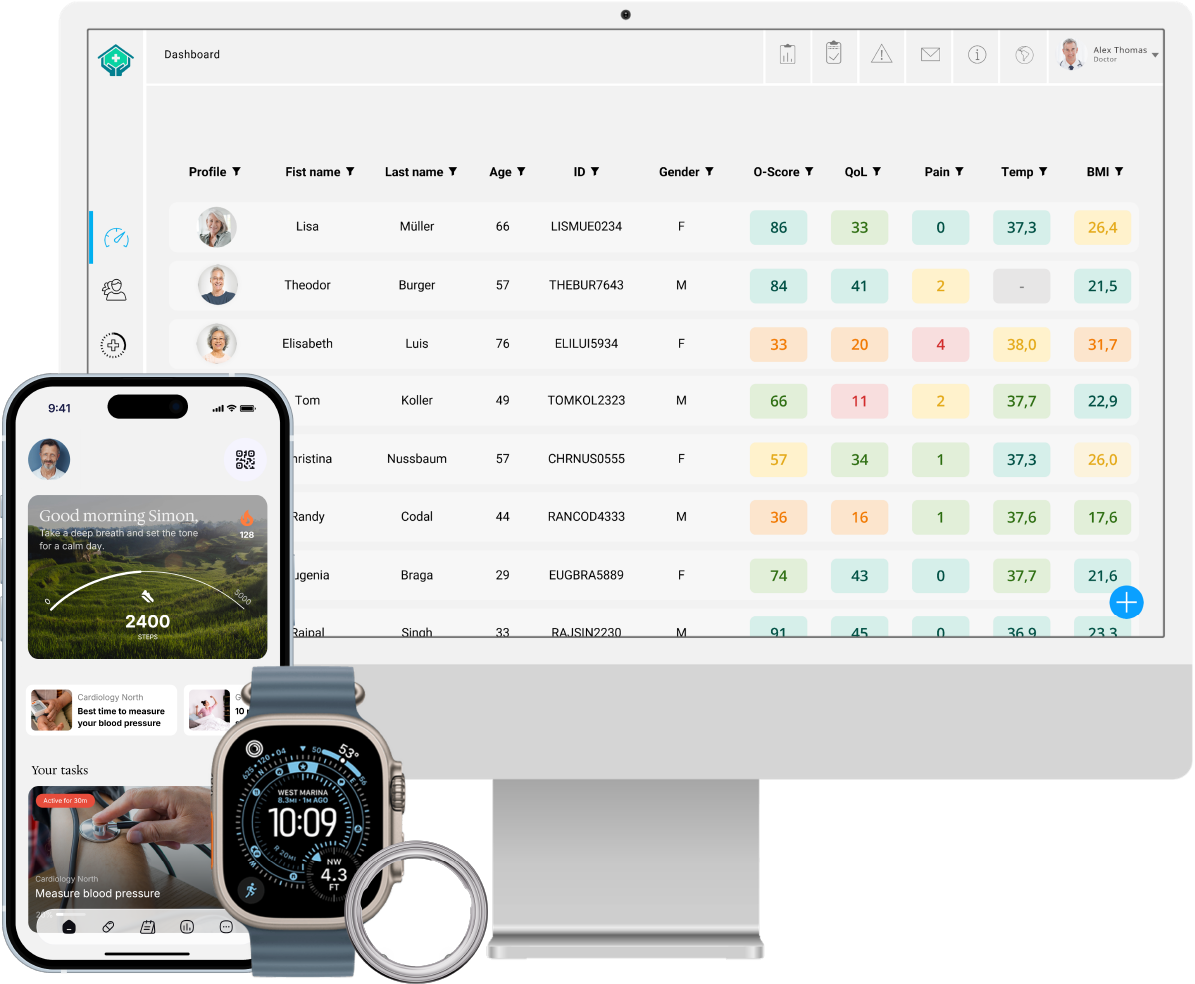
The myoncare app on a smartphone and the care team platform in a browser
For the care team

The cockpit the point person never had.

The care team sees at a glance who is at which stage, who has just crossed a threshold and what it triggered. Patients use the myoncare app or a browser.

  • Patient panel by stageFull patient panel, sortable by CKM stage and time since the last value.
  • Escalation queueWho crossed a threshold and what it triggered.
  • Referral with historyReferral handover with the full stage history attached.
  • Appointments, chat and videoBooking, secure messaging and video consultations in one place.
  • Devices and wearablesApple Health, Google Health, Withings, plus FHIR and HL7 interfaces.
  • Education and documentationPatient education in six languages at a grade 6 to 8 reading level. Monitoring minutes logged automatically against the right CPT code.
The commercial case

Coordination that pays for itself.

CKM stage 2 and above is the cohort CMS built the remote care codes for: two or more chronic conditions, device-based measurements and documented clinical time. Every monitored value and every minute of care management can be mapped to an existing CPT code. myoncare captures it as it happens, so the coordination role finally has a funding model.

4 code families

APCM · RPM · RTM · CCM. The full remote care stack in one platform, billed side by side for the same patient.

CMS Physician Fee Schedule 20265
~$2,784

blended reimbursement per enrolled patient per year at standard care management intensity.

myoncare CPT modeling6
~$139 M

annual run rate at 50,000 enrolled patients across a network.

myoncare CPT modeling6

Modeled figures, not a revenue guarantee. Actual reimbursement depends on payer, eligibility, consent, documentation and the billing requirements for each code. Not billing or legal advice.

Who it’s for

For everyone who runs care as a program.

myoncare is built as infrastructure: one deployment can serve a single practice, a whole network or a health plan program.

Care management at a health planHealth plans

Manage earlier, before it gets expensive.

  • Support members in a structured way by CKM stage
  • Bring in specialties precisely when a threshold is reached
  • Structured documentation that can be analyzed for reports
Discussion within a provider networkProvider networks & ACOs

One pathway for every practice in the network.

  • Shared pathway for primary care and specialist practices
  • Handover with full stage history
  • Multi-tenant for multiple sites and regions
Doctor in a practiceHealth systems & practices

Programs that reach everyday practice.

  • The CKM coordination point person, digitized
  • RPM, RTM, APCM and CCM mapped to CPT codes
  • Treatment decisions stay with physicians
FAQ

What care teams and networks want to know first.

The 2026 AHA/ACC/ADA/ASN Guideline for the Prevention, Detection, Evaluation, and Management of CKM Syndrome. Risk is estimated with the PREVENT equations, and kidney risk is classified per KDIGO.

It digitizes the coordination work: checking values, recalculating the stage, assigning Caretasks and pathways, routing referrals and documenting. A person on your team stays accountable and handles the cases the platform escalates.

Monitoring minutes, device data and clinical time are logged against the matching CPT code for RPM, RTM, APCM and CCM. Whether and how much can be billed depends on payer, eligibility, consent and documentation; your billing team submits the claims.

Adults across CKM stages 0 to 4. Coordination and billing matter most from stage 2 upward, where patients have two or more chronic conditions.

No, you can start without one. FHIR and HL7 interfaces, wearables, home devices and lab feeds can be connected when needed.

The treating physician. The platform prepares and routes; every clinical decision, including on medication, stays with the care team.

A regulated medical device.

The myoncare platform is FDA-listed in the US and certified as a class IIa medical device under the EU MDR. It is developed by ONCARE GmbH, the parent company of myoncare, Inc.

  • FDA-listed
  • Hosted in the US
  • HIPAA safeguards
  • ISO 13485
  • ISO 27001
  • MDR IIa (CE)
  • FHIR-ready

The standards and certifications listed refer to the quality management system (QMS) and information security management system (ISMS) of ONCARE GmbH, which is responsible for developing the myoncare health platform. More on quality & data security

CKM care, coordinated from stage 0 to 4b.

In a conversation, we clarify the target group, implementation route and specialties involved, and show you the pathway, cockpit and patient app.

Book a call

Sources & notes

6 sources

Links to be checked before publication. Modeled figures are labeled as such.

  1. 1Ndumele CE, Rodriguez F et al.: 2026 AHA/ACC/ADA/ASN Guideline for the Prevention, Detection, Evaluation, and Management of Cardiovascular-Kidney-Metabolic Syndrome. Circulation, June 9, 2026. doi.org/10.1161/CIR.0000000000001453
  2. 2Aggarwal R, Ostrominski JW, Vaduganathan M: Prevalence of Cardiovascular-Kidney-Metabolic Syndrome Stages in US Adults, 2011–2020. JAMA 2024;331(21):1858–1860. doi.org/10.1001/jama.2024.6892
  3. 3Palaniappan LP et al.: 2026 Heart Disease and Stroke Statistics. Circulation, January 2026. Deaths 2023; costs 2021–2022. doi.org/10.1161/CIR.0000000000001412
  4. 4Khan SS et al.: Development and Validation of the American Heart Association’s PREVENT Equations. Circulation 2024;149:430–449.
  5. 5Centers for Medicare & Medicaid Services: CY 2026 Medicare Physician Fee Schedule final rule. cms.gov
  6. 6myoncare CPT modeling based on the CMS Physician Fee Schedule 2026; CCM base code 99490, national average $66.30 per patient per month (CMS, 2026). Internal model, August 2026.