Oncology

Cancer care that continues between appointments.

myoncare supports cancer patients digitally: from the first visit through therapy to survivorship care. With ready-made care pathways and minimal effort for your team.

Illustrative example of a patient journey in three phases and three layers: patient, myoncare and care team. Before therapy, the patient records medical history, medication and current symptoms at home; myoncare bundles the information so the medical team sees the baseline at the first visit. During therapy, for example chemotherapy, a baseline and check-ins in every cycle follow. In the second cycle a value is above the threshold, myoncare triggers an alert and informs the care team. In survivorship care, check-ins follow at fixed intervals for up to twelve years. In year two, myoncare reports an abnormal trend as a possible late effect to the care team and survivorship and rehab services.
  1. Before therapyat home
    History
    Medication
    Symptoms
    First visit preparedBaseline complete
    • Medical team at the first visit
  2. During therapyCycles
    Baseline
    Cycle 1
    Cycle 2
    Cycle 3
    Alert triggeredValue above threshold
    • Care team
  3. Survivorship careYears
    Month 3
    Year 1
    Year 2
    Year 3
    Year 5
    Year 10
    Late effect reportedAbnormal trend
    • Care team
    • Survivorship and rehab
Patient journey

Digital support in every phase.

One platform for the whole course of care. Start with one phase or combine all three for continuous support from the first visit to survivorship.

  1. Before therapy

    Prepared first visits

    Before the first appointment, patients enter their medical history, medication and current symptoms at home. Your team sees the baseline before the consultation.

    • Medical history and current medication
    • Symptom baseline and distress screening
    • Patient information and consent, digitally
    How it works
  2. During therapy

    Therapy support

    Support during chemotherapy, oral anticancer therapy, immunotherapy or hormone therapy. With regular check-ins and information for patients.

    • Baseline before therapy starts
    • Symptom and side-effect monitoring
    • Alerts for abnormal results
    Triage and escalation
  3. After therapy

    Survivorship care

    Automated long-term follow-up that captures late effects, recurrence signs and quality of life in a structured way over years.

    • Regular follow-ups on a fixed schedule
    • Early detection of recurrence and late effects
    • Structured documentation of every follow-up
    Survivorship care
The challenge

Cancer care does not end at the clinic door.

Between diagnosis, therapy and aftercare there are often weeks without direct contact. That is exactly where problems arise that the care team only sees late.

Symptoms stay invisible between appointments

Side effects, pain or psychological distress often appear at home and are only discussed at the next appointment.

Symptom capture and documentation take time

Paper forms, manual evaluation and inconsistent documentation tie up staff. At the same time, value-based programs such as the CMS Enhancing Oncology Model ask practices to collect and monitor electronic patient-reported outcomes (ePROs).

Survivorship care runs for many years

Late effects and recurrences can occur long after therapy. Structured follow-up over years is hardly possible without gaps on paper.

For every type of therapy

One principle, four types of therapy.

The process stays the same: prepare, capture between check-ups, report risks. What is asked and how often depends on the therapy. After radiotherapy, patients continue in survivorship care.

Chemotherapy

Support between cycles: nausea, fatigue, mucosal and skin problems as well as warning signs are captured and assessed regularly.

Check-ins in step with the cycles

Oral anticancer therapy

For therapies taken at home: reminders, questions on intake and tolerability, and a direct line to the team when something is not right.

Support without fixed appointments

Immunotherapy

Immune-related side effects can appear with a delay, even after therapy ends. Regular check-ins make changes to the skin, bowel or general well-being visible early.

Also beyond the end of therapy

Hormone therapy

Hormone therapies often run for years. Regular check-ins capture side effects such as hot flashes, joint pain or mood swings and support adherence.

Support over long periods
Triage and escalation

Identify risks before the next appointment.

Every answer is checked against the thresholds your team sets. On this basis, myoncare triages automatically and reports in real time.

Treatment decisions stay with you. myoncare monitors and escalates. Patients receive clear guidance on what counts as an emergency. Monitoring does not replace acute care.

  1. Green

    Stable

    Values are within the expected range. Support continues automatically.

  2. Yellow

    Follow up

    A value is abnormal. Additional questions or contact follow.

  3. Red

    Escalate immediately

    Your team receives the report immediately, with a structured summary, course and recommended urgency.

For the care team

Your patients always in view.

Two views for your team: the overview of all patients in therapy and the detailed view of one person.

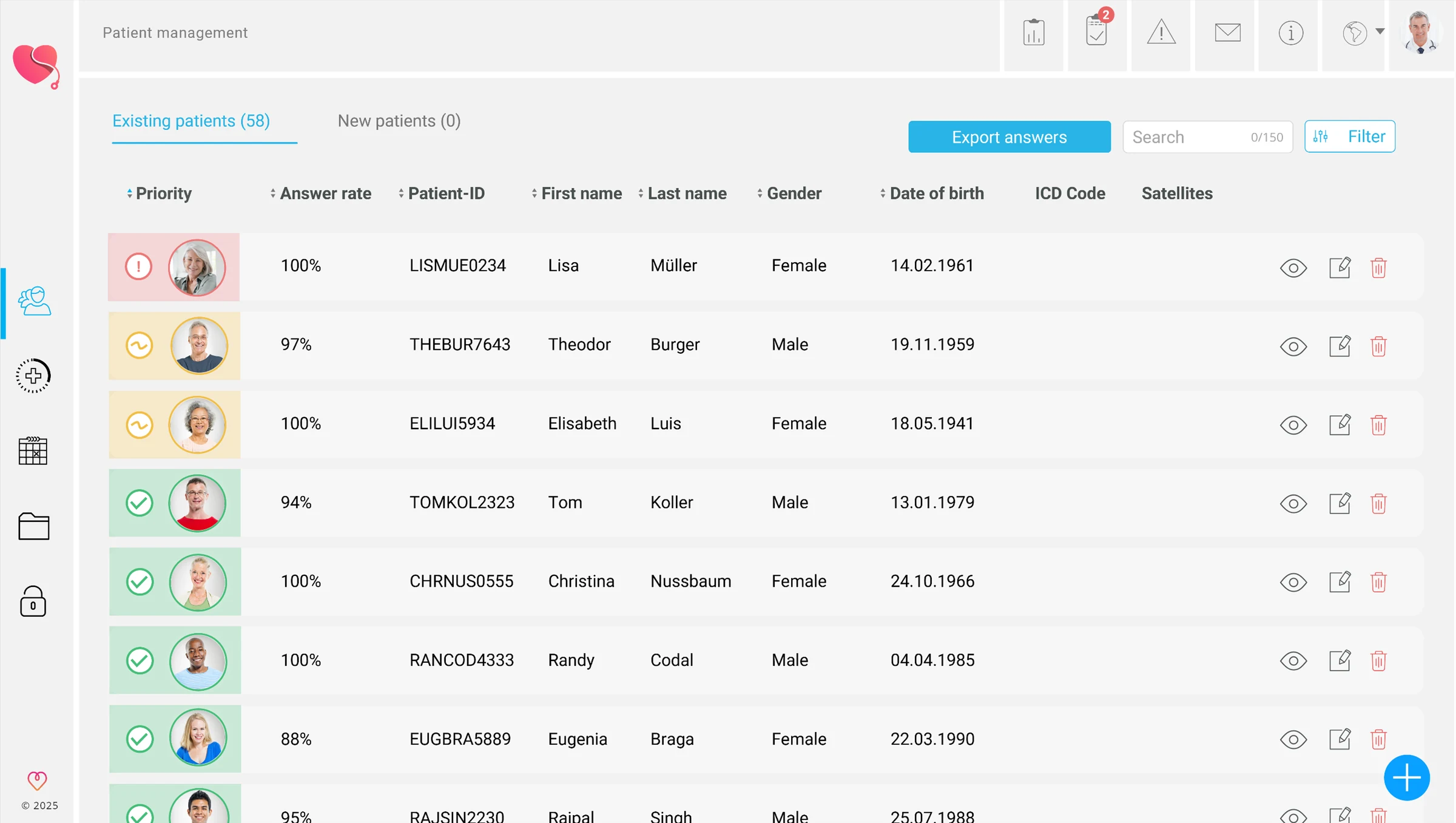
Patient list in the dashboard: patients sorted by priority, with traffic-light status and answer rate
All patients in view

Patient list

All patients in therapy in one list, sorted by priority. The traffic light shows who has reported abnormal values, the answer rate shows who is completing their questionnaires. Before every check-up, your team sees where to act.

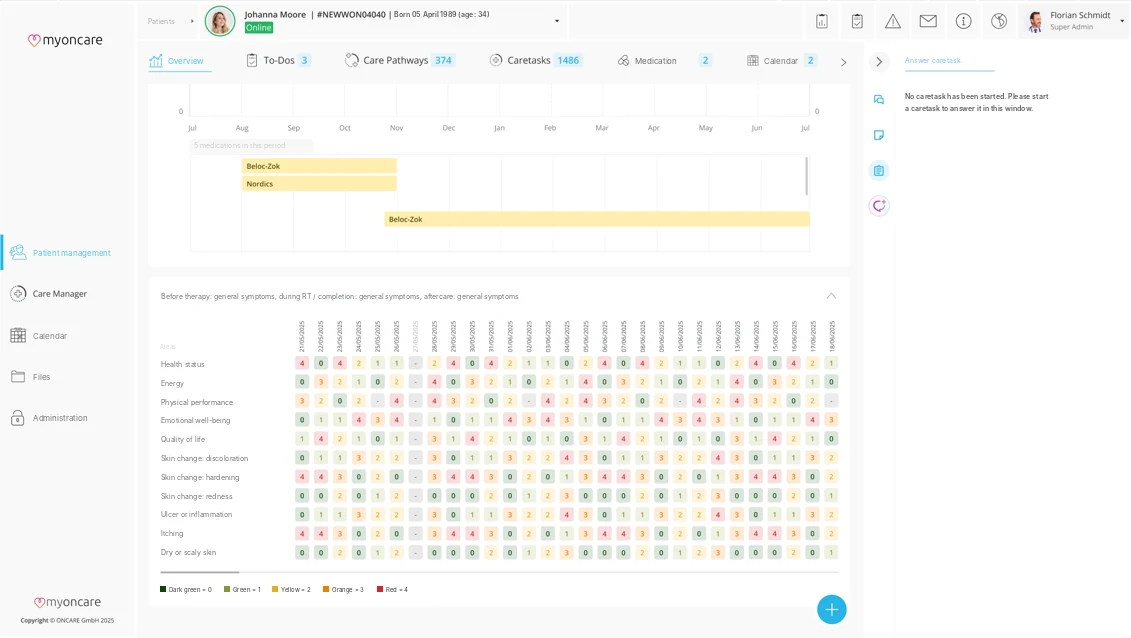
Detailed view of a patient: medication over time and symptom answers before therapy, during radiotherapy and in follow-up, color-coded from 0 to 4
One person in detail

Course view

One person's course across the entire therapy: medication over the period and, below it, every answer from the questionnaires, from before therapy through the check-ups into follow-up. Changes between two appointments are visible at a glance.

Survivorship care plan

Every follow-up plan fits the preceding therapy.

The myoncare recall engine builds the follow-up plan from three factors: tumor type, preceding therapy and individual risk.

  • Tumor typeand stage
  • Therapyand duration
  • Patientand risk
Recall engineIndividual follow-up planWhich questionnaires, at which intervals, over which period. Shorter intervals at first for acute side effects, longer ones later for late effects.
Survivorship

More than tumor control: life after therapy.

Follow-up does not only ask about recurrence. The questionnaires also capture how patients are doing in everyday life and make changes visible over years.

  • State of health, energy and physical performance
  • Emotional well-being and quality of life
  • Late effects in the treated region
  • Monitoring of activity, lab and imaging if needed

For your patients

Regular check-ins provide reassurance: the care team keeps an eye on their health even years after therapy. Simply via app, on a smartphone, tablet or laptop.

Course view in the dashboard: answers on state of health, energy, quality of life and skin changes before therapy, during radiotherapy and in follow-up, color-coded from 0 to 4
Course viewEvery questionnaire answer over time, from before therapy into follow-up. Changes are visible at a glance.
Connected care

A network around the patient.

Cancer care is teamwork. Connect referring physicians, cancer center, radiation oncology, diagnostics and survivorship care, and create a shared data basis for everyone involved.

  • Connect cancer centers with community practices
  • Set individual permissions for everyone involved
  • Everyone involved sees the current course of their patients

Connected via the myoncare platform

2nd prizeMSD Health Award 2026
Reference project · Germany

Digital patient navigator for radiotherapy.

The Department of Radiation Oncology at University Medical Center Mannheim (UMM) in Germany supports its patients after radiotherapy with the myoncare platform. A baseline is captured before therapy, and check-ins follow from the last day of radiotherapy: first at short intervals for acute side effects, later at longer intervals for late effects.

The project received 2nd prize at the MSD Gesundheitspreis (MSD Health Award) 2026 in Germany.

  • 400+active patients in the project
  • 9Pathways for 9 radiotherapy regions
  • 12 yearsof structured follow-up possible

Getting started

Ready to go in a few working days.

  1. Choose phases

    Before therapy, during therapy, survivorship care. Together we work out what suits your center or practice.

  2. Your site is set up

    Your site including care pathways, check-in schedule and recall plan. No integration effort on your side.

  3. Support patients

    Patients start via QR code or link. You see results and abnormal findings in the dashboard.

We monitor and escalate. Treatment decisions stay with you.

myoncare provides the digital support and reports abnormal findings. Medical decisions are always made by the treating medical team.

myoncare is FDA-listed and hosted in the US, with safeguards designed to support your HIPAA obligations.

FAQ

Your questions, answered.

For chemotherapy, oral anticancer therapy, immunotherapy and hormone therapy. After radiotherapy, patients continue in survivorship care, with care pathways for 9 radiotherapy regions.

Validated instruments, for example the NCCN Distress Thermometer, PHQ-9, GAD-7, IPOS and PROMIS-29. Depending on the care pathway, further indication-specific questionnaires are added.

Through traffic-light logic with thresholds. Green means stable. Yellow triggers additional questions or contact. Red leads to immediate escalation to your practice or hospital, with a structured summary, course and recommended urgency.

The treating physician. myoncare monitors and escalates. Patients receive clear guidance on what counts as an emergency. Monitoring does not replace acute care.

Structured monitoring is possible for up to 12 years. The recall plan defines when patients receive questionnaires, depending on therapy, tumor type and risk.

Results are available in the dashboard as structured reports. Reports can be sent securely to your EHR; interfaces via HL7 and FHIR involve additional effort.

No. myoncare provides ready-made care pathways including content. If you want to design your own programs, you can do so in the myoncare editor.

A smartphone, tablet or laptop with an internet connection. They start via QR code or link, for example in the waiting room or with the appointment confirmation.

Support cancer patients digitally. From the first visit.

In a short call, we show you which phases suit your center and what getting started looks like.

Book a call