Two categories, one infrastructure
One regulated platform serving telemedicine networks (Category 3) and university centres for complex conditions (Category 4). One project, two routes to funding.
Category 3 + 4on a single regulated platform
MDR Class IIa certified network infrastructure for telemedicine networks (Category 3) and university centres for complex conditions (Category 4). Application-ready and operational in weeks, not years.
One regulated platform serving telemedicine networks (Category 3) and university centres for complex conditions (Category 4). One project, two routes to funding.
One regulated platform serving telemedicine networks (Category 3) and university centres for complex conditions (Category 4). One project, two routes to funding.
As a Class IIa medical device under the MDR with KIM and FHIR, myoncare meets the statutory criteria and the forthcoming ministry requirements. Operational in 8–12 weeks instead of 12–18 months.
The one-off investment is eligible for federal and state funding; ongoing operation is not. It is carried by hospital usage fees, in time by a selective contract or a disease management programme.
Funding rates under § 12b KHG as amended by the KHAG: from 2026 to 2029 the federal government carries up to 70 per cent of eligible costs. The states provide co-financing of at least 30 per cent and may pass on no more than half of that to hospital operators. The hospital's own contribution therefore lies between 0 and 15 per cent and is handled differently in each state; from 2030 the combined state and operator share is at least 50 per cent. A selective contract requires an agreement with a statutory health insurer and is not a commitment.
The bottleneck is not capital. It is projects that are ready to apply and able to prove their effect.
Projects that began before 1 July 2025 are excluded. For everything after that date, the quality of the project description decides.
Hospitals do not apply to the federal government. The states review, prioritise and file the collective application with the Federal Social Insurance Office. The state level decides.
By this date the Federal Ministry of Health will set binding minimum requirements for telemedicine network structures. Until they exist, the Federal Social Insurance Office approves no Category 3 application, including none of the 78 already filed. Those who are prepared start the moment it opens.
A patient who is prepared, guided and followed up leaves earlier, cancels less often and returns less often. The hospital pays its share once; the effect recurs every year. What a saved bed day is worth depends on whether the bed is filled again. That is why we count additional cases, not bed days.
Lower length-of-stay threshold: 3 days. The model stays above it. Within the threshold range the case rate does not change, so the effect does not come from the revenue of the saved day. It comes from the additional case that moves into the freed bed. What matters is your own length of stay, not the catalogue value.
Consent, history taking and results check happen before the patient travels.
1.5 percentage points fewer cancellationsComplete records, and the schedule survives the day.
Around 11 theatre hours saved per yearPathway control and early mobilisation. Criteria-led discharge.
1.5 bed days per case, around 750 a yearMonitoring and a defined escalation path. Complications stay outpatient.
1 to 2 wound infections avoidedModel calculation for a project under funding category 3 of the hospital transformation fund. All assumptions and sources are listed below the calculator.
In this project myoncare is not a patient portal. It is regulated digital process and control infrastructure for monitoring, pathway management and cross-sector escalation, run as a service for a hospital group.
Funding rates under § 12b KHG as amended by the KHAG: federal government up to 70 per cent, states at least 30 per cent, of which no more than half may be passed on to operators. Hospital own contribution 0 to 15 per cent · 66% of hospitals with an annual deficit in 2024: DKI Krankenhaus-Barometer, 2025.
The legal basis
The two categories can be combined: a network application under Category 3 and a parallel centre application under Category 4, on the same technical basis.
Category 3
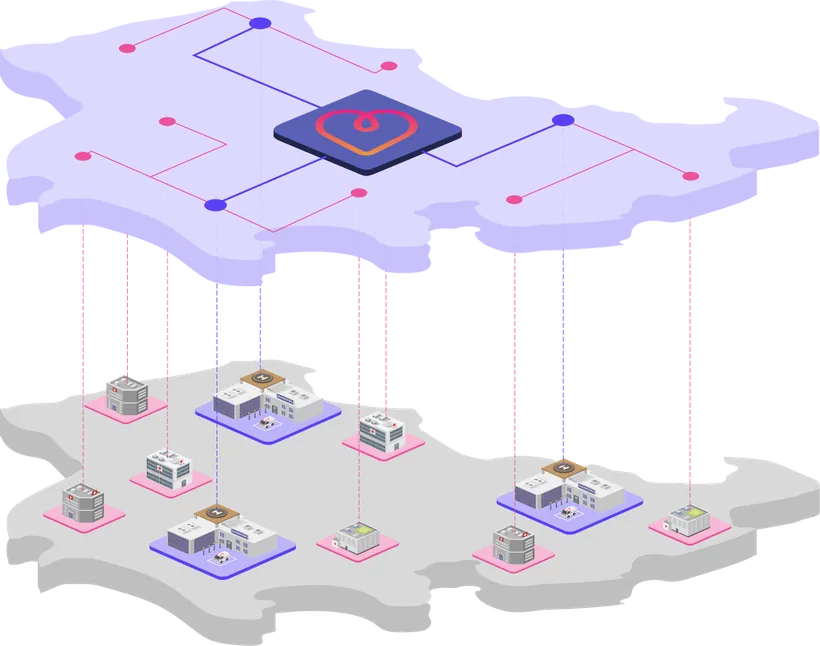
Building networks that make one hospital's particular expertise available to others: teleconsults, monitoring, pathway management.
myoncare is the network infrastructure itself
Several hospitals apply jointly
Meets the nationwide interoperability requirements
Category 4
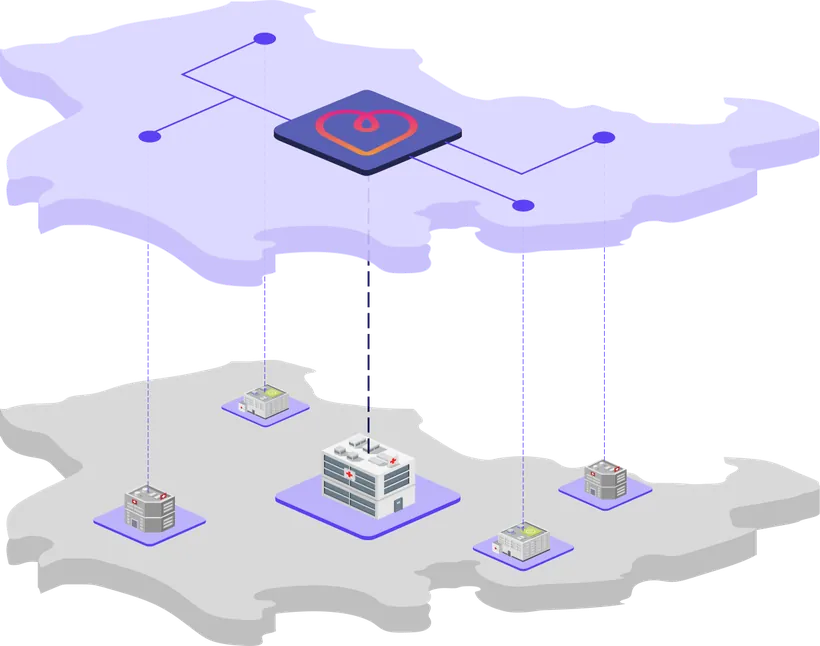
Concentrating treatment expertise at a university centre. myoncare is the digital hub-and-spoke layer between the centre and the periphery.
Connects the university centre with peripheral hospitals
Teleconsults and pathway management across sector boundaries
Extendable by indication, with no new infrastructure
Wording per § 12b (1) sentence 4 nos. 3 and 4 KHG, set out in detail in § 3 KHTFV.
The difference
Conventional model
HIS integration
Deep · 12–18 months
Monitoring
Per hospital, manual
Connecting practices
Fragmented, laborious
Change management
Heavy
Further indications
A new project
Refinancing
Unresolved
myoncare
HIS integration
Lean · 8–12 weeks
Monitoring
Central, as a service
Connecting practices
KIM or browser, no setup
Change management
Little to none
Further indications
A module on existing infrastructure
Refinancing
Selective contract, DMP or cost savings
A content management system for clinical teams and content creators, delivered to a native app or a progressive web app. Editable in real time, with no app update.
Straightforward creation of clinical content and linking to pathways, now with AI support.
Dashboard with heat maps and triage filters, detail view with trends and progress curves.
Whenever predefined thresholds are crossed in either direction.
For direct patient communication and virtual case conferences.
Eligible for funding is the one-off investment: setup, configuration, initial KIM and FHIR integration, and implementation coordination. Ongoing operation (licence, hosting, monitoring as a service) is not eligible, but can be refinanced along three routes.
A care fee per patient per quarter. Requires an agreement with a statutory health insurer.
€50k to €80k per year per hospital, within normal digitalisation budgets.
Parkinson's and MS are disease management programme indications. Statutory reimbursement applies without a separate contract.
(1) Funding rates under § 12b KHG as amended by the KHAG: federal government up to 70 per cent from 2026 to 2029, states at least 30 per cent, of which no more than half may be passed on to operators. Hospital contribution 0 to 15 per cent, rising to up to 25 per cent from 2030. Procurement at full market price and compliant with German public procurement law, with no discount and no special state-aid construction.
We work with established consultancies and implementation partners to deliver projects professionally and quickly.
We map the relevant service groups, the basis of your corporate and clinical strategy.
We assess your funding potential, then define and prioritise suitable projects against your state's deadlines.
We guide the two-stage process: registration with the state ministry, transparent costing, and every deadline met.
Seamless integration of myoncare into your operation, including training for your staff.
The states decide on funding applications. Hospital operators register projects with the responsible state ministry. For telemedicine network structures the Federal Social Insurance Office will only approve once the Federal Ministry of Health has set the nationwide minimum requirements.
Hospitals do not apply to the federal government. The states review, prioritise and file the collective application with the Federal Social Insurance Office. An early, well-prepared outline sent to the state creates an advantage.
Yes. As a Class IIa medical device under the MDR with KIM and FHIR R4, myoncare is the network infrastructure itself (Category 3) and the digital hub-and-spoke layer between centre and periphery (Category 4). Anchored in § 12b (1) sentence 4 nos. 3 and 4 KHG.
Eligible is the one-off investment: setup, configuration, initial KIM and FHIR integration, and internal project costs, at 85 to 100 per cent through federal and state funds. Ongoing operating costs are expressly not eligible. Operation is carried by hospital usage fees, in time by a selective contract (§ 140a SGB V) or a disease management programme (§ 137f SGB V). Both require agreement with the payers.
In 8–12 weeks instead of 12–18 months. Run as a service, with minimal HIS integration and practices connecting via KIM or a browser, with no elaborate on-site setup.
Procurement takes place at full market price and in line with German public procurement law, with no discount and no special state-aid construction. The project therefore stays clean under both procurement and state-aid law.
Your next network or centre project: regulatory sound, technically ready, economically viable.
Let's talk